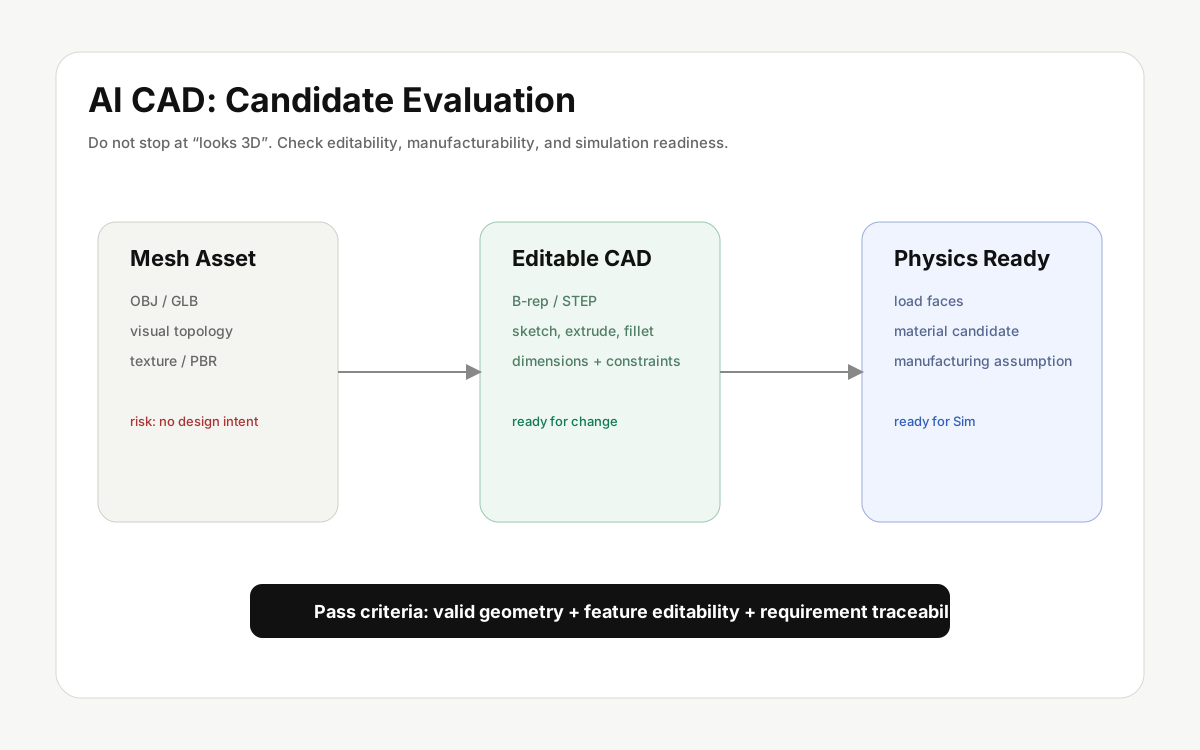
The meaningful AI CAD question is not whether a model can produce something that looks 3D. It is whether the result remains editable as CAD: sketches, dimensions, feature order, constraints, and construction history. As of June 24, 2026, serious research is moving toward parametric CAD sequences, tool-using CAD agents, and validation loops.
CAD as program, not image
DeepCAD framed CAD as operation sequences rather than only geometry. Text2CAD moved toward natural language to parametric CAD. Newer work such as CAD-Recode and Zero-to-CAD treats CAD as executable code or construction history, because executable sequences can be inspected, edited, and re-run.
What benchmarks say
Text2CAD-Bench evaluates 600 human-curated cases across complexity levels. Its core message is practical: current models are more plausible on simple primitives and sketch-extrude workflows, but degrade on complex topology, advanced features, and real-world domains.
Why agents matter
CAD is a long-horizon tool task. ToolCAD treats LLMs as agents interacting with a CAD engine, because generation must be executed, checked, revised, and re-run. Compile success is not enough: geometry validity, editability, dimensional intent, manufacturability, and physical performance matter.
Physics-in-the-loop
Physics-in-the-Loop argues that CAD agents need explicit engineering verification in the loop. A generated shape should be evaluated against load cases and functional criteria, not only visual plausibility.