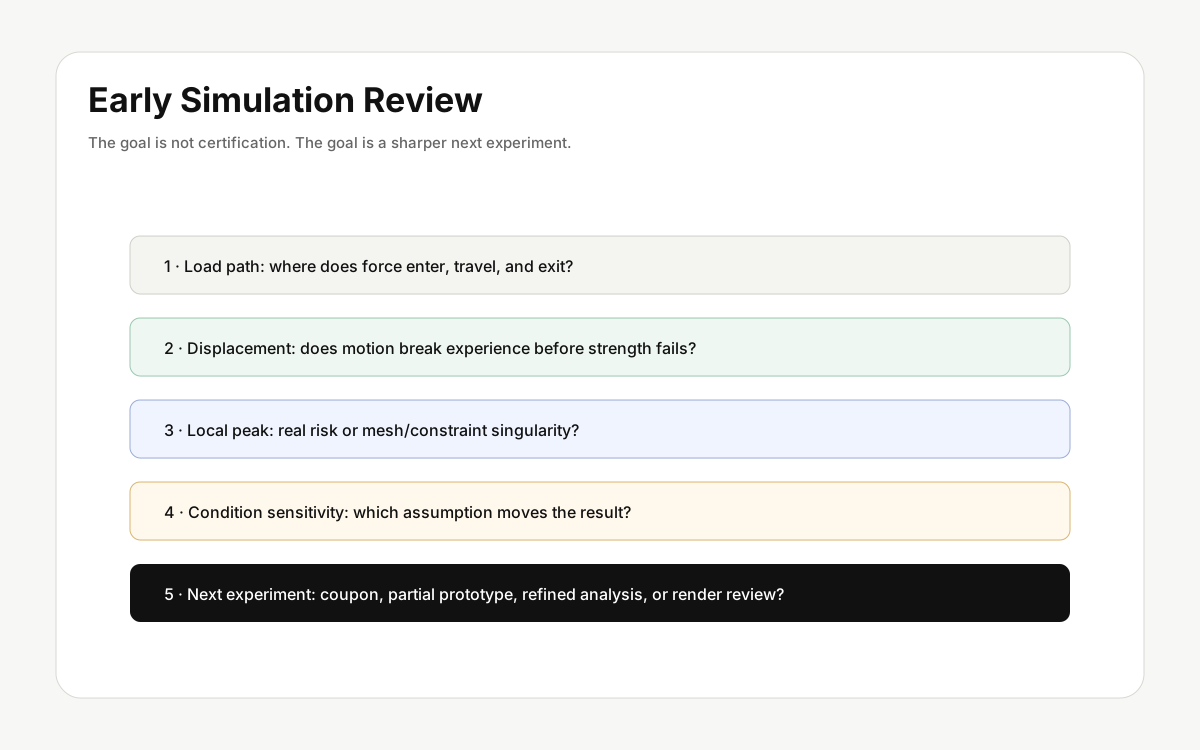
Early simulation should not pretend to be final certification. Materials, manufacturing, and use conditions are still moving, so the goal is to expose risky assumptions and compare candidates.
The useful output is not a perfect report. It is a clearer design conversation: which feature is weak, which assumption dominates the result, and which candidate deserves deeper review.
1. Does the load path behave as intended?
Watch where force enters, travels, and exits the structure. A wall bracket may fail around fasteners rather than across the main plate. A UAV frame may show risk around motor mounts and arm joints before the center plate matters.
2. Will displacement harm the experience?
A part does not need to break to fail. Excessive movement can hurt button feel, assembly gaps, noise, perceived quality, or clearance to nearby parts. Early design review should look at displacement patterns as seriously as stress peaks.
3. Is the risk broad or only a local artifact?
A tiny red point near a sharp corner or artificial constraint may not represent the real design risk. Ask whether the pattern survives mesh changes, more realistic constraints, and multiple design candidates.
4. Are the conditions dominating the result?
Overly rigid constraints, point loads, or simplified contacts can exaggerate risk. Missing impact, heat, or repetition can hide risk. A good review asks which assumption moves the result the most.
5. Which candidate deserves deeper review?
- If displacement is the issue, review rib direction, section height, and load path.
- If local stress is the issue, review fillets, fastener area, and sharp edges.
- If heat is the issue, compare surface area, contact resistance, and airflow direction.
- If weight is the issue, separate high-risk and low-risk regions before removing material.
6. What experiment comes next?
Simulation is an input to the next experiment. The next step may be a refined analysis, a partial prototype, a measured load test, a render review, or customer feedback. RHXY Sim is designed to make the condition, risk area, candidate comparison, and next review item visible in one project context.