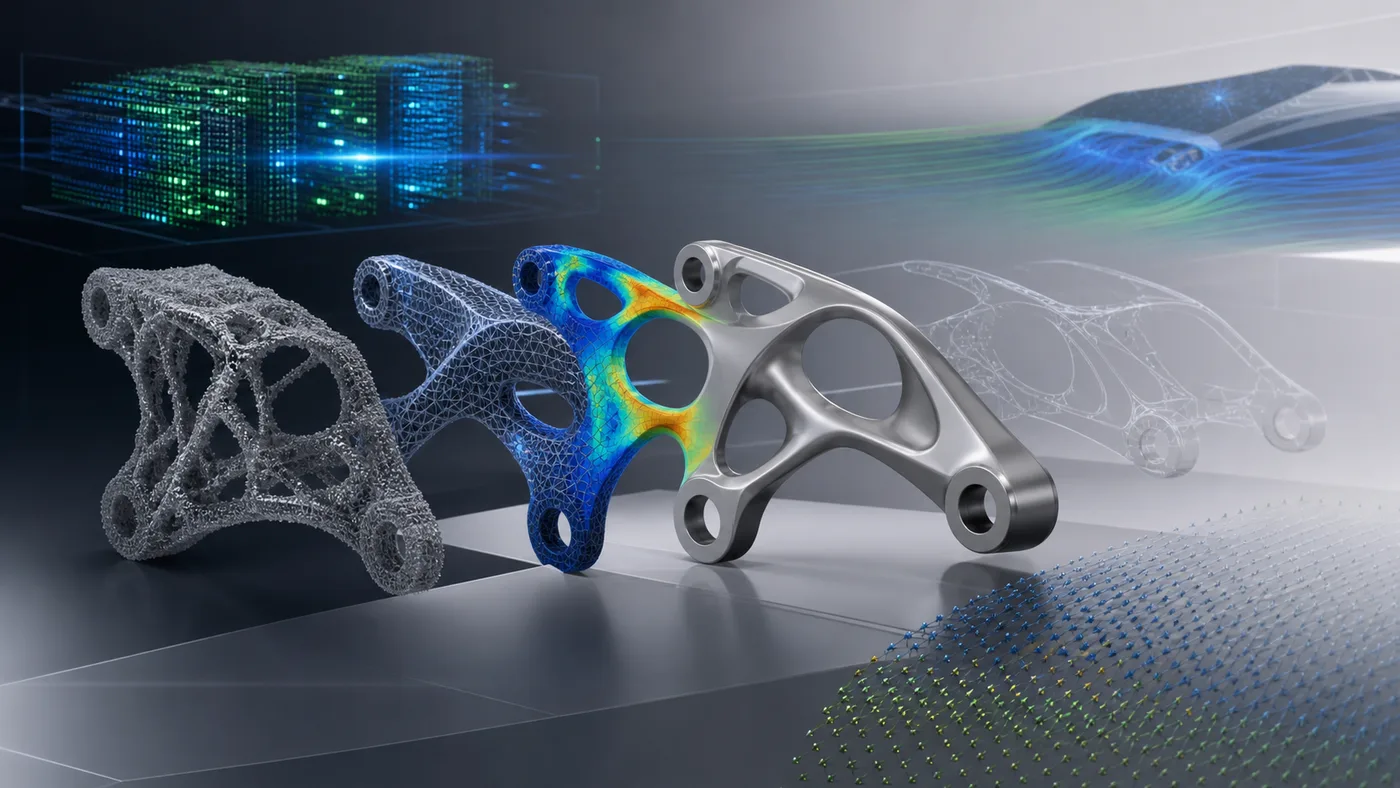
We have put two of our in-house AI engineering engines — AETHER (shape exploration and optimization) and Morpheus (CAD reconstruction of AI-generated geometry) — into a real hardware development project, and field validation has begun.
Not a lab benchmark: we are using these engines directly on the design of a product that has to be built and put in the water. This post shares honestly what works, and how far we can support it today.
The problem we are solving
The stage for this validation is a sensor device that must detect tiny vibrations on a water surface. The core question is simple but hard.
"Which shape best detects small surface vibrations while still floating stably?"
There is a fundamental tension here. Make it sensitive and it becomes unstable; make it stable and it becomes insensitive. A single shape has to satisfy both. Human intuition alone cannot review hundreds of shape candidates. That is where AETHER comes in.
AETHER — explore thousands of shapes and narrow them down
By varying design variables (diameter, height, mass distribution, shape family, and more), AETHER automatically generates thousands of shape candidates and ranks them on physical criteria.
What AETHER actually did in this validation:
- Computed buoyancy, center of mass, and restoring stability for each candidate, automatically filtering out shapes that would sink or capsize.
- Compared multiple shape families (smooth spindle, disc, dish, and others) on the same yardstick rather than fixating on one form.
- Surfaced trade-offs people easily miss — which shapes lead on stability, which lead on detection performance.
It narrows hundreds to thousands of candidates down in minutes, presenting the few strong candidates an engineer should focus on. That is AETHER's first role.
The real value of field validation — the loop turns
When you use an engine in real development, things invisible in controlled experiments surface. We do not hide them — we use them as the force that makes the engine more precise.
In this validation we found a place where one shape-evaluation metric needed to be sharper. The initial scheme did not cleanly separate stability from detection sensitivity. As soon as we confirmed it, we:
- Redefined the detection metric with a more physically accurate definition (response-to-input transfer ratio),
- Reflected the nonlinear character of the shape in the evaluation, and
- Separated stability and sensitivity into two independent axes so each shape's trade-off is clearly visible.
After the fix, all regression tests passed and the results became far more honest and interpretable. Discovery, refinement, and re-validation turn as a single cycle.
This is why we emphasize field validation. AETHER is not a "finished answer machine" but a living engine that grows precise quickly by hitting real problems — and we control that refinement process ourselves.
Where AETHER is especially strong is clear: in domains with explicit physics — geometry and statics (buoyancy, center of mass, stability, mass distribution) — it matches independent hand calculations exactly.
Morpheus — turning AI-made shapes into usable designs
When AETHER explores a shape, the result is a mesh (surface data). To actually manufacture it, you need an editable CAD model. That is where Morpheus comes in.
Morpheus reconstructs AI-generated geometry into a verifiable CAD (STEP) model. In this validation:
- Parts made of regular geometry like planes and cylinders were reconstructed with effectively zero error.
- Shapes with organic curved surfaces were also converted to CAD successfully; curved-surface precision is under further refinement.
In other words, the flow "AI generates a shape → reconstruct it into verifiable CAD" was completed end-to-end once. It means AI-generated design no longer stops at an idea — we have built the bridge to real manufacturing.
So, what can we support
- Shape exploration & optimization — auto-generate thousands of candidates, rank on physics, narrow to strong ones
- Multi-form comparison — quantitatively compare different shape families on one yardstick
- Stability–performance trade-off analysis — expose design tensions people miss, in numbers
- AI generation → CAD reconstruction — convert exploration output into manufacturable CAD
- Precision-refinement loop — fold field findings into the model immediately, re-validation automated
And we are not stopping here. For domains needing higher precision, such as fluid forces, we are advancing our own flow-analysis engine alongside a learning-based refinement path — a direction aligned with current scientific machine-learning research, into which our engine architecture connects naturally.
Closing
We do not say "AI just hands you the optimal design." Many tools say that, but real hardware is not made that way.
What we build is different: AI rapidly narrows a vast space of possibilities, validation confirms it, and what field use reveals makes the engine more precise — a closed improvement loop.
AETHER and Morpheus are running that loop on a real product right now, and we can see these engines grow visibly sharper each quarter. If you have a design problem you'd like to solve together, reach out.
This post shares the progress of an ongoing validation and contains no specific project or customer information.