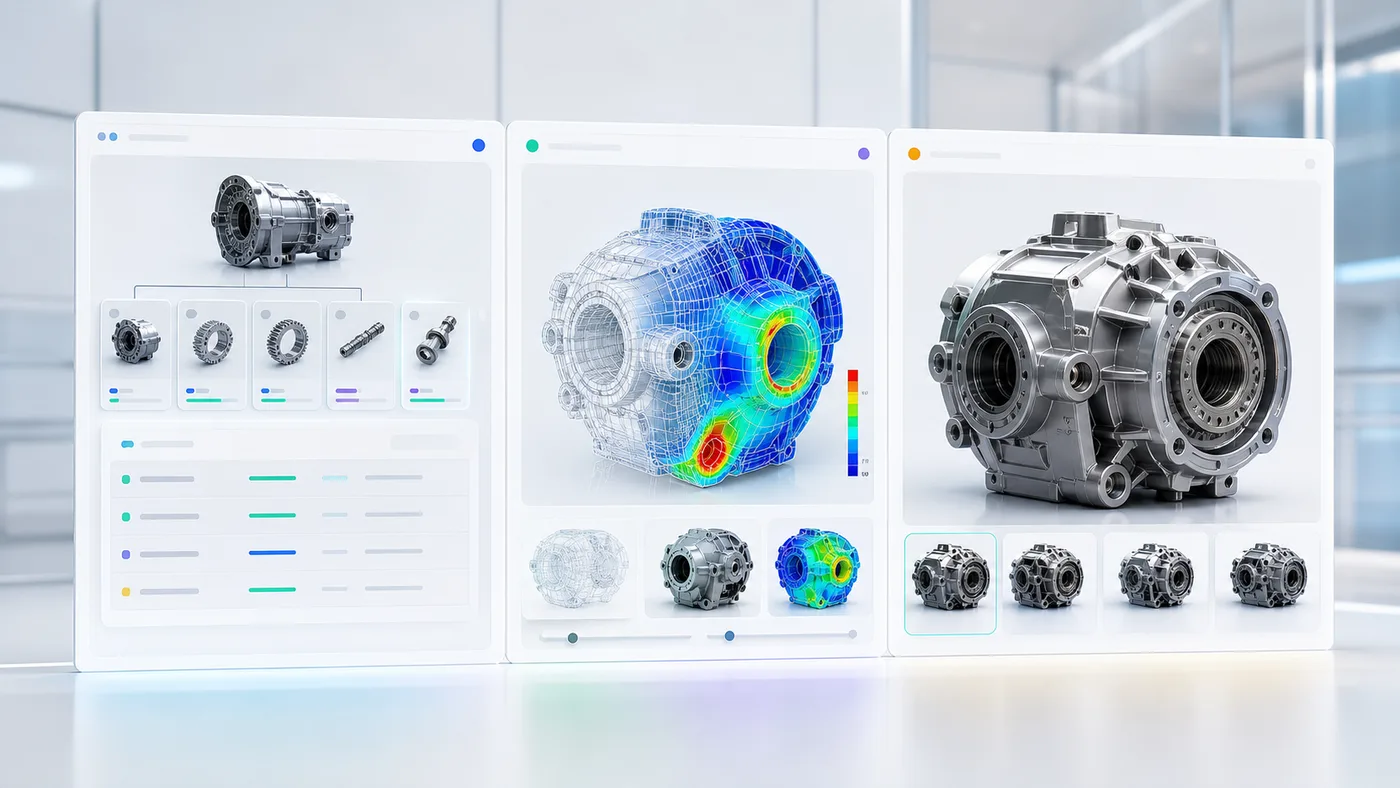
RHX has officially begun the private beta of its AI engineering platform, RHXY. Of the several engineering workflows RHXY will cover, this beta opens around the first stage: simulation.
Why now
Engineering simulation (CAE) — structural and thermal analysis — is the most powerful way to check "will this design hold?" before anything is built. Yet few people can actually wield it: choosing the analysis type, defining materials, applying loads and constraints, meshing, and judging whether the result can be trusted has stayed inside the specialist's domain.
So many people with good ideas move on without ever confirming whether their design is sound. RHXY was built to close exactly that gap.
How it works
Alongside a CAD file, you describe what you want to check in plain language — for example, "I want to see if this bracket holds under a 5 kg load."
RHXY translates that intent into analysis conditions:
- It reads the structure of the uploaded CAD model and detects meaningful geometry features — bolt holes, mounting faces, load faces, thin walls.
- It proposes analysis type, material, mesh size, and load/constraint candidates.
- If your intent is ambiguous, it does not just move on — it asks (clarify), proceeding only after the missing conditions are filled.
- But it applies nothing automatically. Every condition runs only after you approve it.
After running the approved setup, RHXY returns a report — and it does not stop at throwing numbers at you. It also checks and explains whether the result can be trusted: did the solver converge, were boundary conditions applied correctly, are stress and displacement physically plausible, was the mesh sufficient.
What the AI does, what the solver does
The single most important thing to understand about RHXY: AI does not replace the solver.
The actual analysis is solved not by AI but by CalculiX, a standard solver validated over three decades. The AI's role is different — to guide a non-expert to set the analysis up correctly, and to turn the solver's output into judgments a human can understand.
- Setup stage: geometry-feature detection, condition recommendation, readiness check (consistency of material, load, constraint, mesh, analysis type)
- Result stage: confidence check, and failure diagnosis (mesh failure, boundary-condition issues, unit issues, solver failure, and so on)
- And it accumulates all this analysis history and failure/correction data as learning data.
So we do not say "AI automatically guarantees the analysis." We say: "AI guides the setup and validation process and turns solver results into judgments a human can understand."
We call verified only what is verified
We chose not to promise broadly from the start. RHXY's analysis coverage is wide, but not every capability is at the same maturity — so we deliberately separate them.
Validated core — what we say with confidence (verified against reference solutions and standard cases):
- Linear static structural (stress, displacement, safety factor, reaction forces, suspected singularities)
- Modal / natural frequency (eigenfrequencies, mode shapes)
- Buckling (buckling factors, structural stability)
- Thermal (temperature fields, thermal boundary conditions)
- Thermal-structural coupling (structural response under thermal loads)
- Harmonic / dynamic (frequency- and time-response, baseline scope)
Supported, but with validation still being strengthened: surface-to-surface contact (representative-case stage); advanced options (large deformation, plasticity, creep, bolt pretension, fracture, and more) under expert review; material nonlinearity and 3D-printing anisotropy, experimental / under validation.
So this release is scoped to what we have confirmed against the reference — linear static structural analysis and steady-state heat transfer. We could have shown more, but we chose to call verified only what is verified. That restraint is where we can stand honestly today.
The boundary we keep honestly
RHXY accelerates early design review and iteration. Expert review is still required before final certification or safety-critical design, and we do not claim accuracy guarantees, safety guarantees, expert-free certification, full automation of all analysis, or complete CAD understanding.
What we provide is clear: solver-backed results, a confidence check on those results, and what to do next (next action).
In one line
RHXY is an AI-based CAE copilot: upload a CAD model, AI proposes analysis type, material, mesh, and load/constraint candidates, you approve them, it runs structural/thermal/dynamic analysis, and it explains the confidence of the result and how to improve it.
Where this beta is heading
RHXY's strongest position is not "a replacement for established professional CAE," but a solver-backed AI simulation layer that non-experts can use — letting someone who does not know professional CAE upload a CAD model, run an analysis with AI guidance, and judge for themselves whether the result can be trusted.
The private beta is rolling out in stages to several pilot projects and teams. Rather than opening wide, we validate narrowly and firmly, shaping the product against real problems in the field; the feedback of teams who validate with us decides what we open next.
Hardware, for anyone — the first public step in that direction.