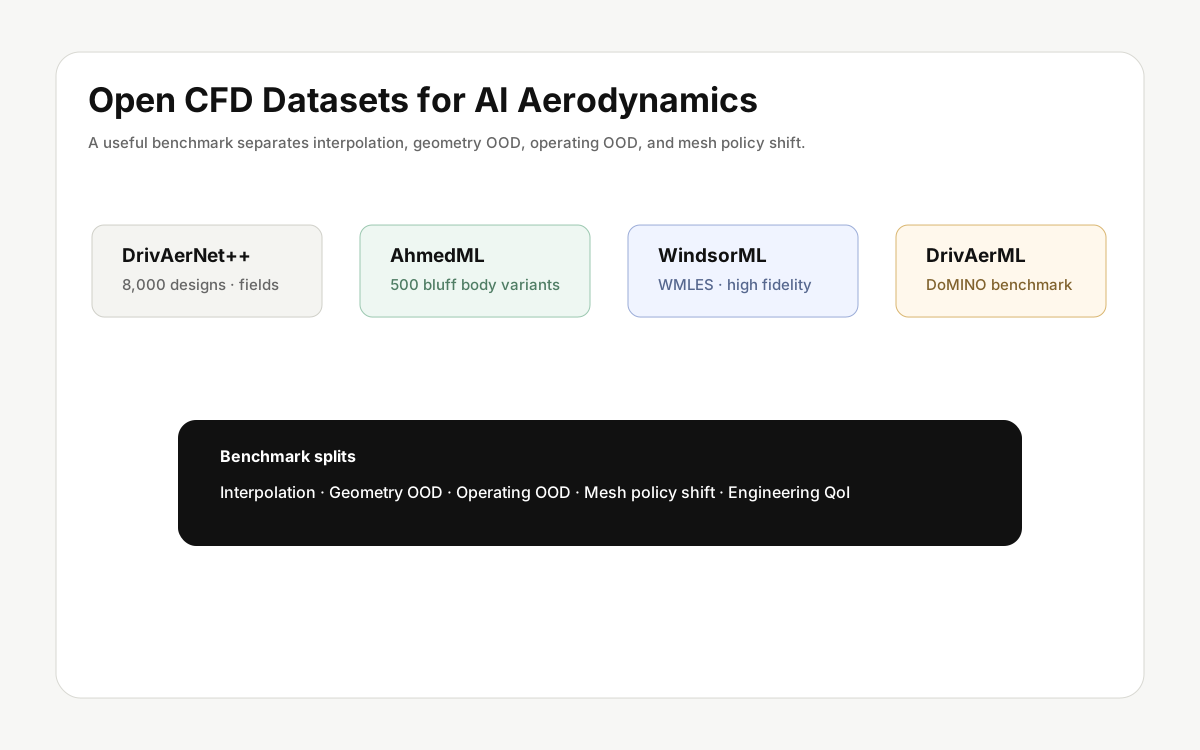
One of the biggest bottlenecks in AI aerodynamics has been data quality. Industrial CFD depends on geometry, mesh, turbulence model, boundary conditions, solver setup, and post-processing. Without transparent datasets, AI models stay trapped in toy problems.
Important datasets
DrivAerNet provides thousands of car meshes and aerodynamic data. DrivAerNet++ expands this to 8,000 diverse car designs and more than 39 TB of public engineering data. AhmedML contributes 500 Ahmed body variants with high-fidelity CFD. WindsorML provides 355 Windsor body variants using high-fidelity WMLES with very large cell counts.
Benchmarking matters
PhysicsNeMo's DoMINO example uses DrivAerML, and recent benchmarking work compares DoMINO, X-MeshGraphNet, and FIGConvNet on automotive aerodynamics metrics. This moves AI CAE from isolated model claims to comparable engineering evidence.
What to inspect
- Geometry diversity.
- Solver fidelity and turbulence model.
- Mesh, domain, and boundary-condition consistency.
- Available outputs: coefficients, surface fields, volume fields.
- Validation, license, and reproducibility.