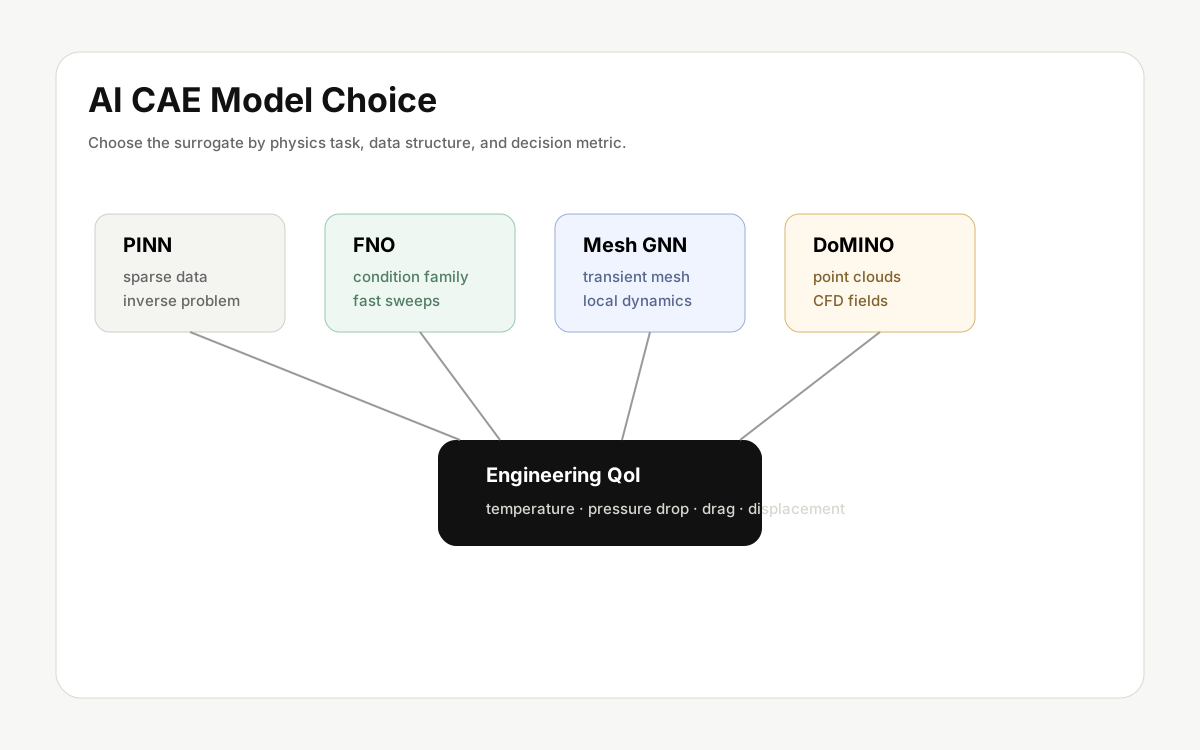
AI CAE is not only “PINNs solving PDEs.” As of 2026, the field combines PINNs, neural operators, graph networks, point-cloud operators, diffusion models, and reduced-order models depending on the target task.
From solver instance to solution family
FNO and neural operators learn maps between functions, making them useful when teams need repeated evaluation across geometry, boundary condition, material, or operating-condition variations. MeshGraphNets shows how mesh-based dynamics can be learned with graph networks.
Industrial CFD surrogate direction
DoMINO, developed in NVIDIA Modulus/PhysicsNeMo, targets large-scale engineering simulations such as automotive aerodynamics. It predicts surface and volume fields from point-cloud and local geometry information, with evaluation using engineering metrics.
Model choice matters
PINNs can be useful for inverse problems and sparse data. Neural operators suit repeated evaluations over a problem family. GNNs suit mesh topology and transient dynamics. Point-cloud operators suit complex geometry field prediction. ROM plus neural operators remains relevant for real-time digital twins.